
Vision Correction Surgery with LASIK and Wavefront

What are Refractive Errors
Plano and Wavefront Assisted Customised LASIK Surgery
Who is Suitable for LASIK
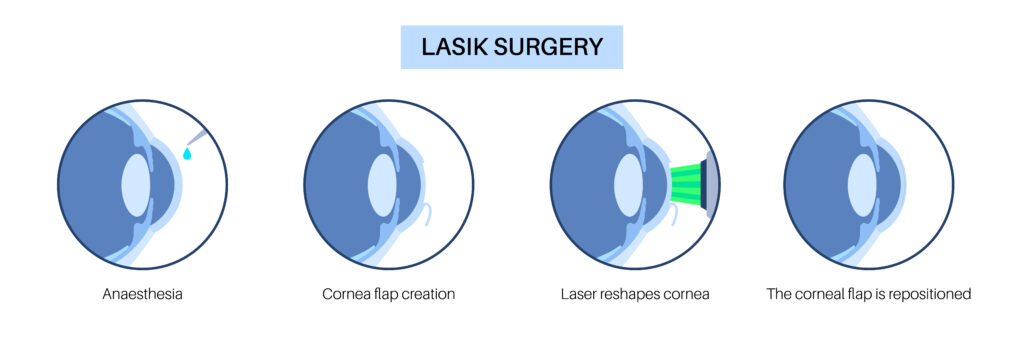
Before the Laser Procedure
During Surgery
After Laser Surgery
- First check-up on the morning after surgery
- Seven days after surgery
- One month after surgery
- Three months after surgery
- One year after surgery
- When Will You Know the Result
Possible Side Effects
Undercorrection/overcorrection: Undercorrection may sometimes be planned intentionally or may occur as an unintentional effect. As a result, the eye may remain short¬sighted. If the degree of residual myopia is significant, you may be treated again later. Overcorrection occurs very rarely.
Glare/haio effect: You may feel some sensitivity to light at night or in bright sunlight. Sometimes in dim light, you may see a faded ghost image around the sharp bright image. This will pass after the first few days or weeks.
Decrease in contrast sensitivity: Some people find that their night vision has become a bit dull. This happens because of a decrease in their ability to discriminate between different contrast levels. The Wavefront assisted procedure [ C-LASIK] minimizes night vision problems since minute imperfections and aberrations are also taken care of.
Flap complications: Rarely the anterior corneal flap that is made in LASIK may not be complete. In such situations the flap is repositioned and surgery may be re¬attempted after three months. In very rare instances, the flap may tear or become detached.
Corneal ecstasia: This can occur if the corneal thickness is less to begin with, or if the cornea is thinned more than it can withstand. Persons with low corneal thickness are not suitable for LASIK. And another procedure called LASEK or surface ablation is advised. If this applies to you then you will be told at the time of initial assessment.